
Other Blogs


All Blogs

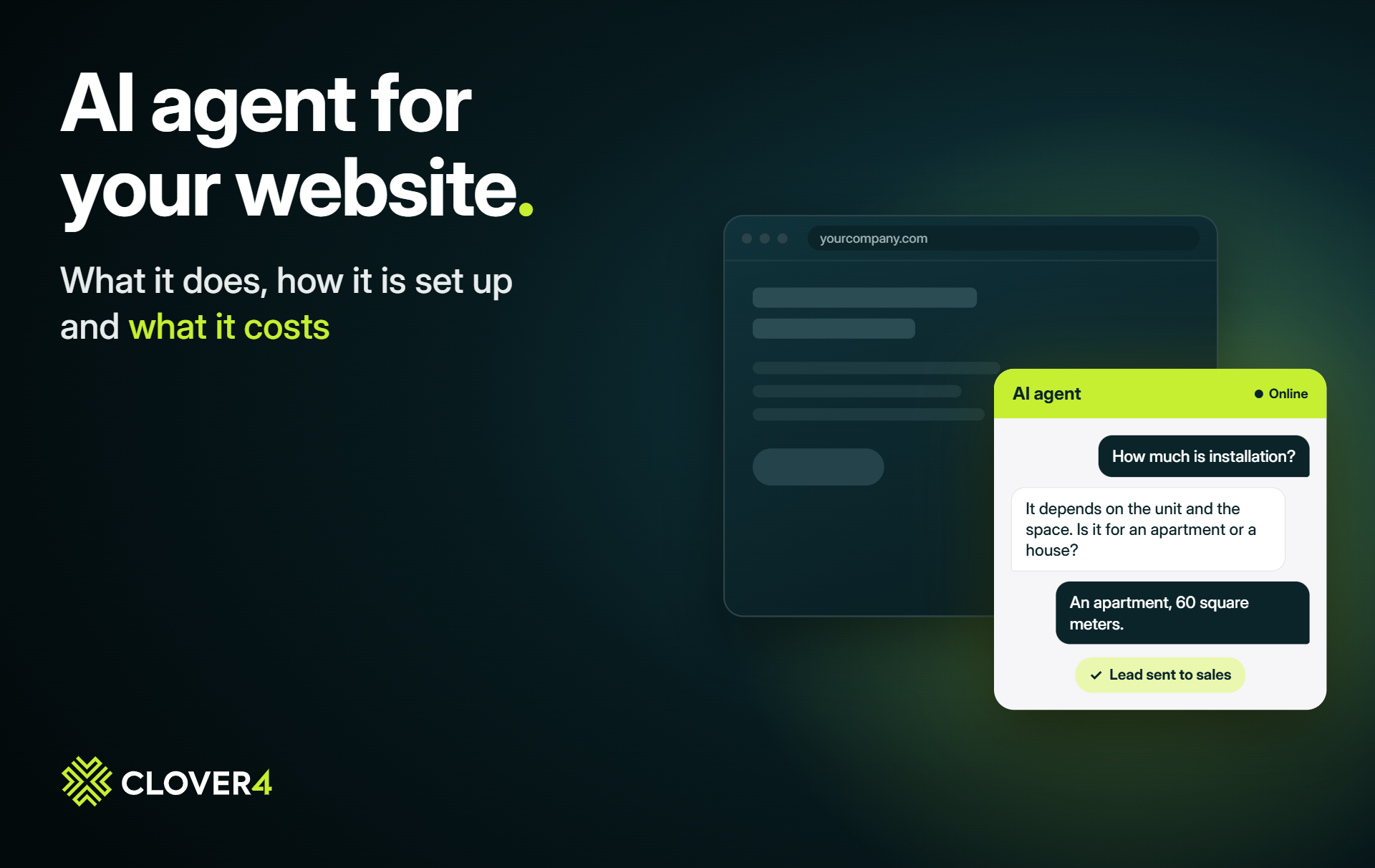

An AI agent for your website is software that talks to your site's visitors, answers their questions and guides them to the next step: an inquiry, a booked meeting or a purchase. People often search for it as a website chatbot, but the difference goes beyond the name. Before you introduce one, you need to make two decisions: what you need and who will build it.
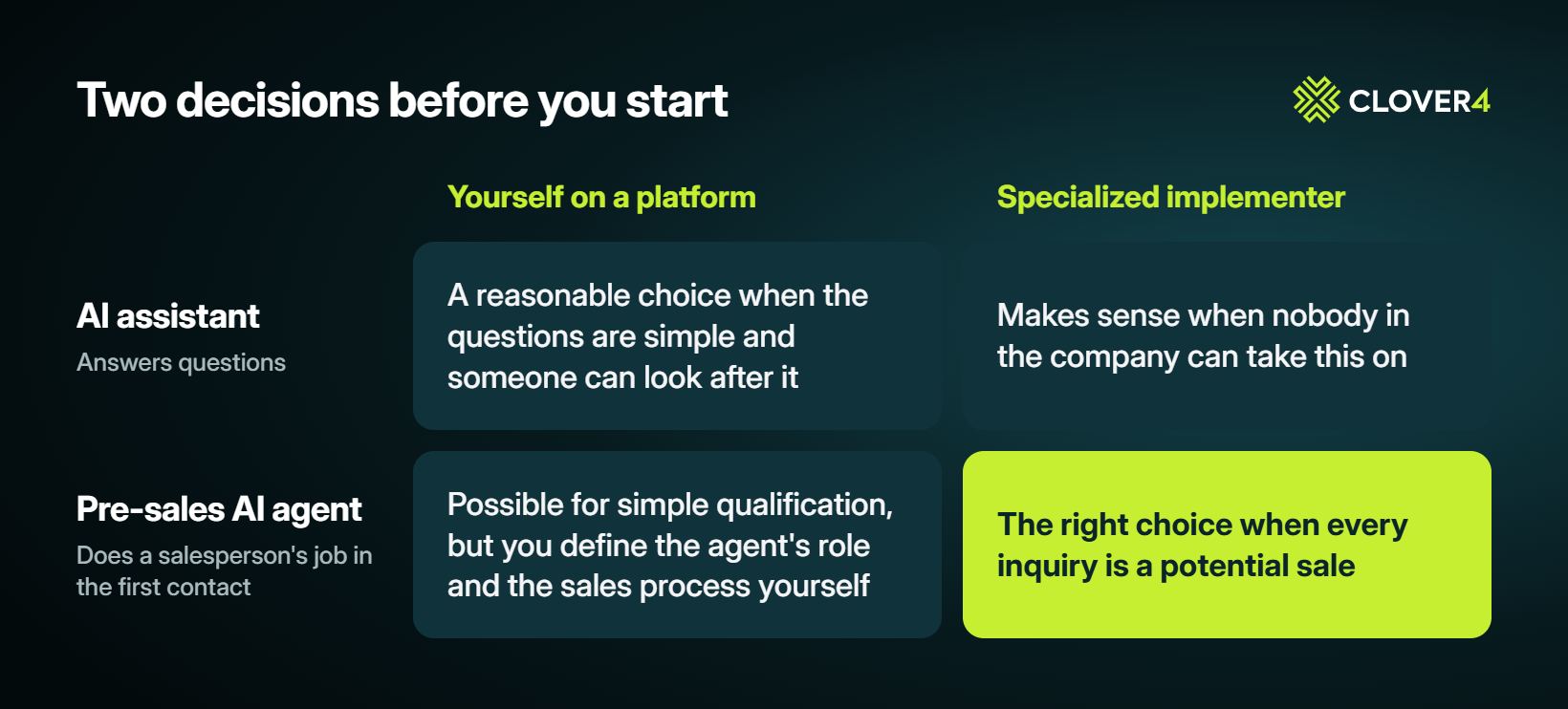
First you choose the type: an AI assistant that answers questions, or a pre-sales AI agent that does a salesperson's job in the first contact with a customer. Then you choose who builds it: you yourself on a ready-made platform, or a specialized implementer such as Clover4.
The most expensive option is not always the right one. A company with a dozen frequent questions and few inquiries does not need an agent costing several thousand euros. For a company where every inquiry can become a sale, an assistant that only answers leaves money on the table.
An AI agent on a website does what a good salesperson who is always available would do. It answers questions, recommends a product or service, qualifies interest and steers the conversation to the next step. When the conversation ends, your team receives an email with a summary and all the key details, so the salesperson does not start from zero.
The agent's role on a website can vary widely. For example, on a hotel website it can cover direct room bookings, MICE inquiries, weddings, spa and restaurant reservations. Each of those conversations has a different customer, different questions and a different next step.
Every role needs one measurable goal. For most companies that is a created lead: the contact details of a customer who has passed qualification, or a booked meeting. In a webshop it is usually a purchase.
With the AI agents Clover4 builds, the average conversion rate from conversation to lead is 30%. We measure this number in our client portal, on real conversations. What it will be for you depends on the industry, the quality of your website traffic and how well the agent is prepared.
You can. Platforms such as Chatbase let you build an agent without programming, fill it with your documents and put it on your website. According to Chatbase's price list on November 3, 2026, plans range from 32 to 400 dollars per month with annual billing, with 700 to 15,000 message credits per month. That is considerably cheaper than a custom build.
These tools can do a lot today, including connecting to other systems and working across several channels. The biggest difference lies in the work a platform cannot do for you:
So count the working hours, not just the price of the plan. If someone in the company can dedicate time to it, and the questions are simple and repetitive, building it yourself is a reasonable choice. If there is no such person, a cheap tool easily becomes an agent that was set up once and that nobody looks at again.
The essence is in the approach. A good implementer gets into the company's business and sales processes, talks to management and sales, and only then builds the agent, drawing on experience from other projects. You do not get that part from Chatbase or from any other platform.
An AI assistant answers when asked, while a pre-sales AI agent steers the conversation toward a goal. Both use artificial intelligence and both can sound natural, so the difference does not show in the first message. It shows in what happens after it. We described the difference between old menu chatbots and AI agents in the article Chatbot vs AI agent.
For example, a visitor to the website of a company that installs air conditioners writes: "Do you do installation and how much does it cost?"

The assistant answered correctly and the conversation ends there. The agent answered too, but it also got the information it needs to recommend a unit, check whether the customer is serious and offer a time slot.
An assistant is a good choice when the goal is to relieve the team of repetitive questions, such as working hours, delivery or complaint terms. An agent makes sense when an inquiry can turn into a sale, especially when customers compare several offers and when the speed and quality of the first conversation affect who they contact.
Building an AI agent for a website with Clover4 costs from 500 to 15,000 euros, and monthly maintenance from 250 to 5,000 euros. The lowest prices apply to the simplest solution, and the range is this wide because "a website agent" can mean very different things. Three things move the price the most:
An AI agent is added to a website with a snippet of code, so you do not need to change the site itself. The technical part is the smallest. Most of the work comes before that: defining the role and goal, preparing the knowledge, connecting systems, shaping how the conversation runs, and testing. The whole process usually takes a few weeks, and we described it step by step in the article How to Build an AI Sales Agent.
The first version can also start without integrations, using only knowledge from the website and documents, and connections to systems are added later. That way even a company with a smaller budget can start with one role and expand the agent once it sees results.
Whoever you choose, these five answers will show whether a provider builds agents or just installs a tool:
The choice depends on what one inquiry is worth to your company. If the questions are simple and you have someone to look after it, start with an assistant on a platform. If every inquiry is a potential sale, a pre-sales agent and an implementer who will build and monitor it pay off.
Clover4 is a Belgrade-based company that builds custom AI agents for companies in Serbia and the region, on websites, Instagram, Facebook, WhatsApp, Viber and SMS. If you want to see how this would look for you, book a free demo.


