
Other Blogs


All Blogs


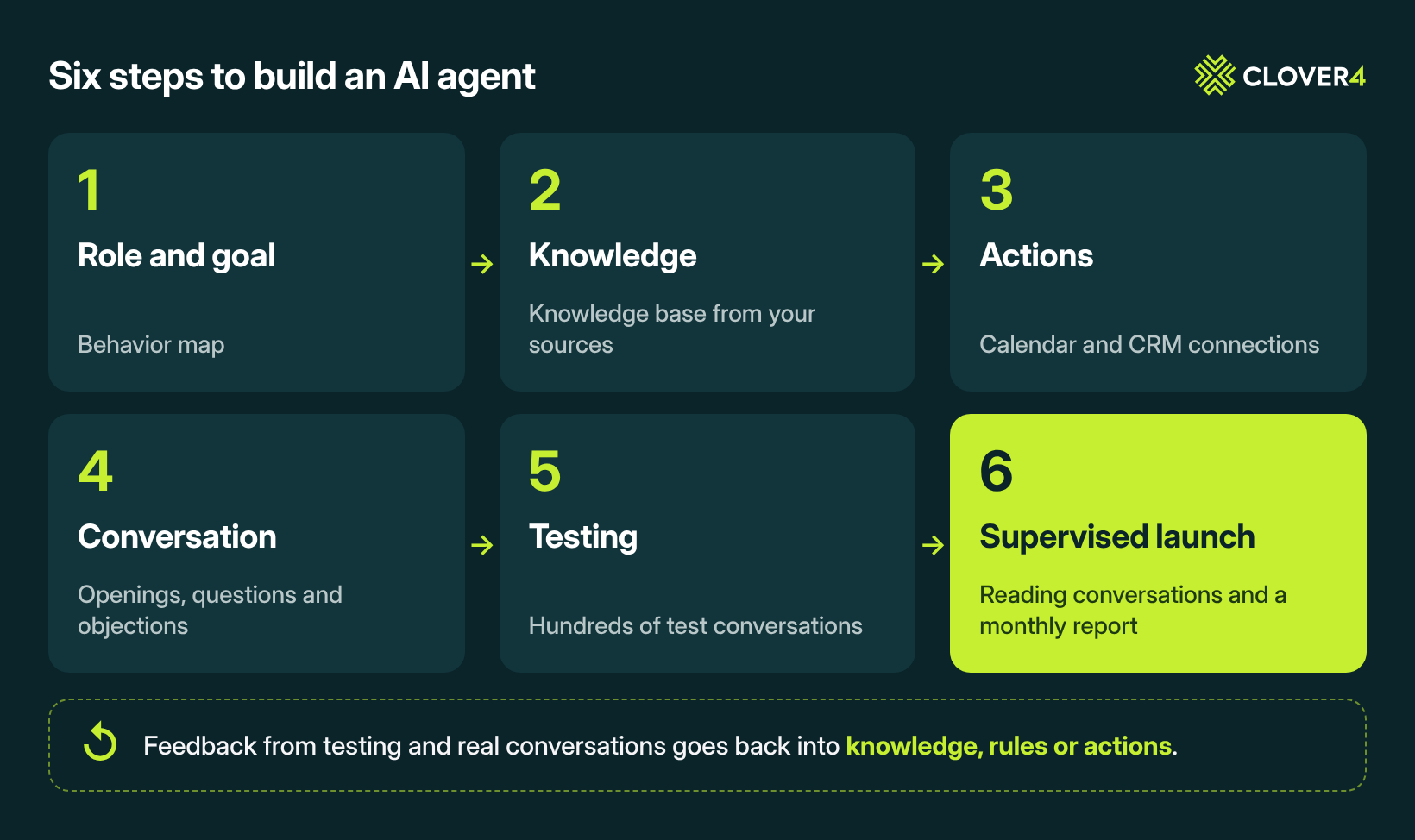
An AI sales agent is built in six steps: defining the role and goal, the knowledge, the actions and the way it runs a conversation, followed by testing and a supervised launch. The whole process takes a few weeks, and the timeline depends mostly on the scope of the knowledge and the number of integrations.
When we first talk to a company about an AI agent, the questions are usually technical: which model runs in the background, how it connects to the website, how many integrations are needed. We always answer them, but the result rarely depends on that. It depends on the questions you would ask a new salesperson in their first week: what is your job, what do you need to know, what are you allowed to promise and when do you call a colleague.
That is why we bring the agent into the job like a new salesperson, always in the same order:
Below we describe each step the way we do it on projects, along with the mistakes we corrected along the way.
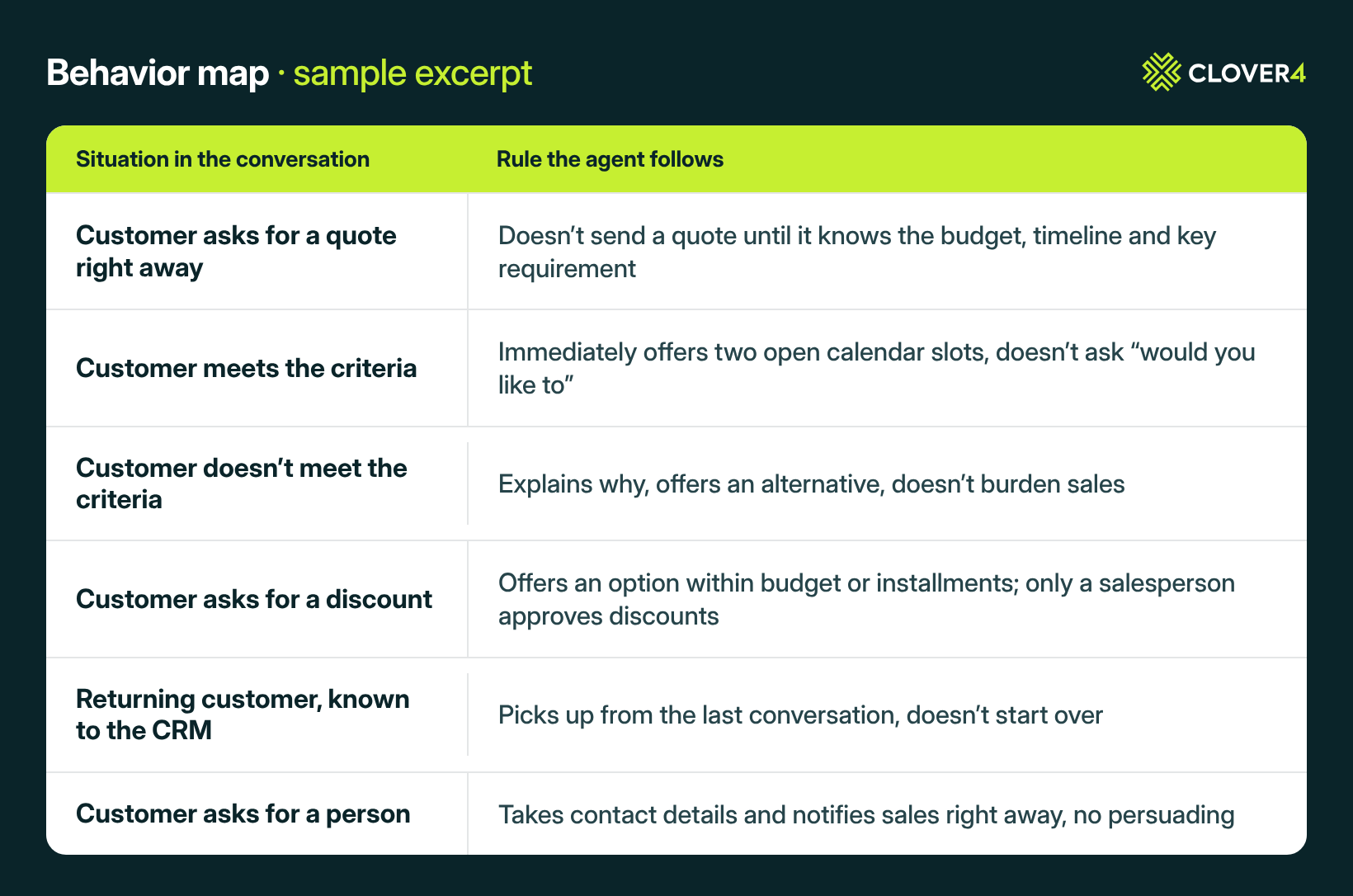
The agent's role and goal are defined in a behavior map, a document that is to the agent what a job description is to a new hire. The map comes out of conversations with sales, not with IT: we want to know how your best salesperson runs a conversation, what counts as a qualified lead for you and how a conversation should end. It contains scenarios, the questions the agent asks, objections and the answers to them, tone, boundaries and the moment when a person gets involved.
The goal has to be single and measurable. For a sales agent it is a created lead: a booked meeting or the contact details of a customer who has passed qualification. The agent does the job of a setter, and your salesperson closes the sale. In a webshop it is different: there the goal is a purchase.
The method comes from you. If your team qualifies using BANT or its own questionnaire, the agent does the same, so for example it does not send a quote until it knows the budget, timeline and key requirement.
A map is rarely right the first time. With a prefabricated home manufacturer, the first version took customers who had a plot and a budget straight to scheduling, because it seemed they did not need any questions. That was wrong. Such a customer knows they want to build, but often not what. Now they go through the same questions and get the same model recommendation as everyone else, and only the tone and the priority of appointments differ.
The second mistake was too much caution. With an event venue, our first version sent every sensitive question to a person in sales. On paper that was safe, but in conversation the agent came across as useless. Now sales is mentioned right away in three cases: when the topic is an available date, when the question is not in the knowledge base, and when the customer negotiates the price or asks for an exception. The agent handles everything else itself, including a rough cost estimate, and the invitation to talk to sales comes when the conversation has progressed or the customer shows clear interest.
We write down the boundaries just as precisely: what the agent must not promise and what it does when it does not know the answer. The reason is not a formality. In 2024, Air Canada lost a case before a tribunal in British Columbia because the chatbot on its website gave a passenger wrong information about its bereavement fare terms. The company argued that it was not responsible for what the chatbot wrote, and the tribunal rejected that argument. To the customer, what the agent writes is what your company said.
We write rules as rules, not as sentences to be recited. The agent should draw conclusions from context and judge for itself whether the next step in the map makes sense at all. A customer who gave the date and number of guests in their first message should not be asked about the date and number of guests.
We agree on tone through examples, because a description like "friendly and professional" does not say much. The same opening can sound like this: "Dear Sir or Madam, thank you for your interest in our products. How may we help you?" Or like this: "Hi! Happy to help with your heating. Is it for a house or an apartment?" The second version sounds like a salesperson and immediately asks the question that moves the conversation forward.
The agent's knowledge includes what you would give a new colleague: the catalog, prices and terms, technical data, frequently asked questions, the answers to objections your team already uses and references for a customer who hesitates. The sources are the website, documents and the systems where the data already lives, such as a CMS, CRM, ERP or booking engine.
The agent answers from your sources, not from general knowledge. If there is no answer, it says so and passes the question to the team.
The decision we make here is what can be static and what has to be read from a system. A package description can sit in the knowledge base and be changed as needed. At a real estate agency, where listings, photos and statuses live in the CRM, the agent should read from the CRM, because a copy quickly goes out of date. The first version can also start without integrations, using only knowledge from the website and documents, and connections are added later.
When the offer is broad, a single agent that knows everything becomes generic. In that case we build specialists by category. An agent for air conditioners does not need to know everything about heating, but it does know who to hand the conversation to.
The most useful thing we learned about knowledge came from testing. When the event venue's team tried the agent for the first time, one of their main complaints was that it kept referring people to sales. It looked like a behavior problem, but most of that list turned out to be gaps in the knowledge base: the agent referred people to a person because the information was not there. The opposite case is more dangerous. An incorrect fact written into the rules themselves takes priority over the knowledge base, so the agent repeats it even when the knowledge base has it right.
During the conversation the agent books appointments, enters leads into the CRM, notifies sales and does the follow-up, which means it also does what a salesperson would otherwise do after a conversation:
Each of these actions requires access: to the calendar, the CRM and, for internal systems, an API or a structured data export. We check this at the start, because the timeline depends on it. We also agree on who receives notifications and in what form, so that a lead does not end up in an inbox nobody reads.
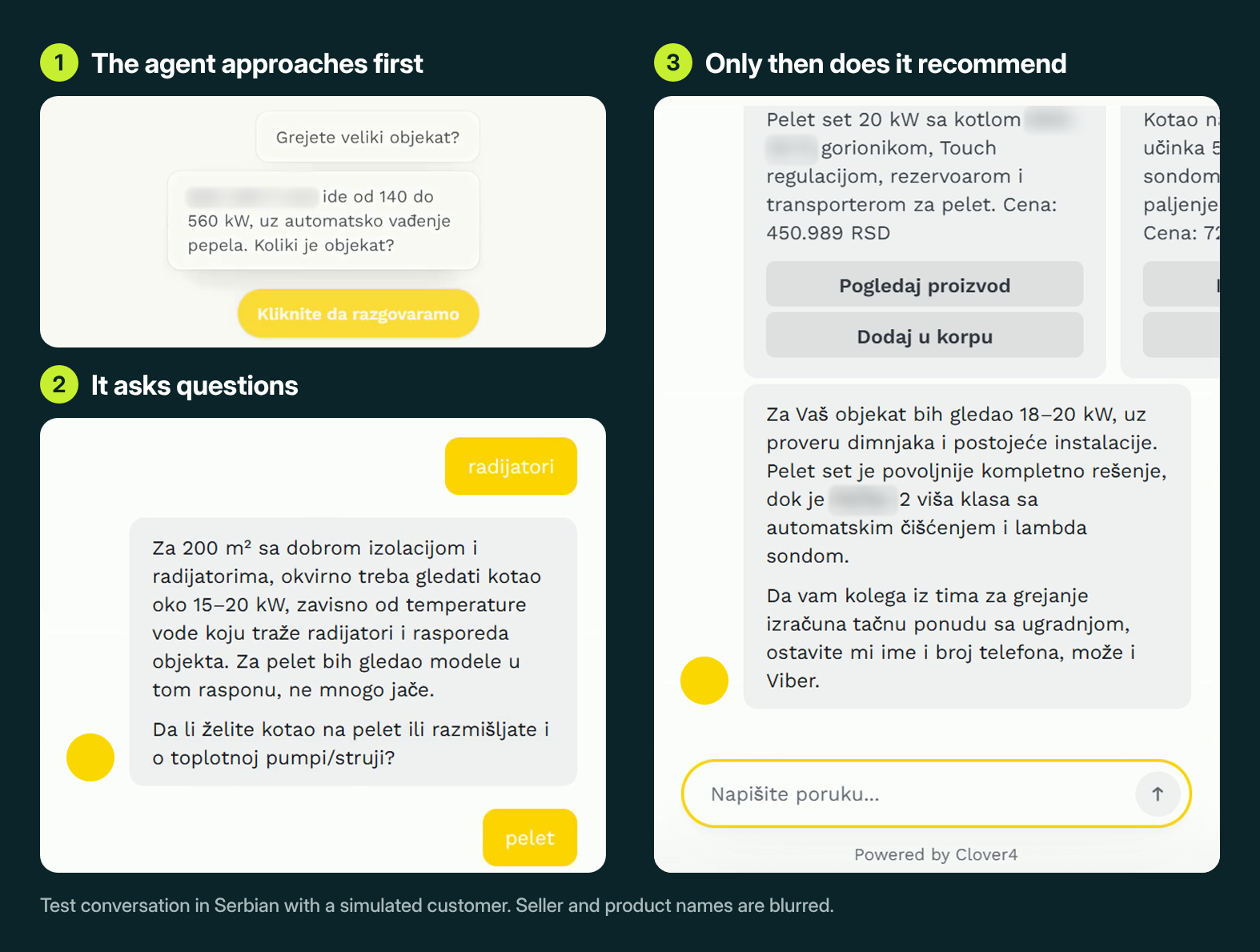
The agent approaches the customer first, asks questions and only then recommends. It opens the conversation with a question about what the customer is looking at. On a heat pump page, that is a question about the floor area to be heated, not the same greeting that appears on every page.
In one test conversation on the website of a heating equipment seller, a visitor opened a product priced at RSD 8.9 million. The agent did not push that boiler, it asked about the building instead. For 200 square meters with good insulation and radiators, it suggested an 18 to 20 kW pellet boiler at around RSD 450,000, and a second, higher-end option at around RSD 720,000. It asked for contact details only after the recommendation.
We treat an objection as a question. When someone says "that's too expensive", the agent does not defend the price, it asks what budget the customer has in mind and looks for what fits. A customer it cannot help gets a polite refusal: it explains why and offers an alternative if there is one, so sales does not spend time on an inquiry that cannot be fulfilled.
Throughout all of this, the customer has to be able to ask anything. An agent for air conditioners has to answer even when someone asks which model has an app, noise below a given level and a price under RSD 50,000, and then pick up where it left off.
Before launch, the agent is tested on hundreds of test conversations. First we go through the scenarios from the map, and then through what the map does not cover: off-topic questions, a customer who does not meet the criteria, a customer who changes the subject mid-conversation.
After that, the client's team tests the agent, because people in sales know questions we would never think of. We tie each comment to the place where it gets fixed: the knowledge base, a rule or an action. That way a knowledge gap does not get patched with a new sentence in the rules.
After launch we read real conversations, fix mistakes and send a report every month. On the website, the technical part itself is small: the agent's code is added and the site stays as it is. The bigger job is reading conversations, because customers write differently from the people who test.
Here is an example. At one client, the owner pointed out to us that the agent on Instagram replied as if the person had not written anything. We reviewed 100 real conversations and found the cause: a greeting that makes sense on a website, where it is sent when the window opens, was arriving on Instagram as a reply to the customer's first message. A person writes a specific question and gets "how can I help you". At least 12 conversations ended right there. The fix took a matter of hours, but the mistake only surfaced in real messages, on a channel that behaves differently from a website.
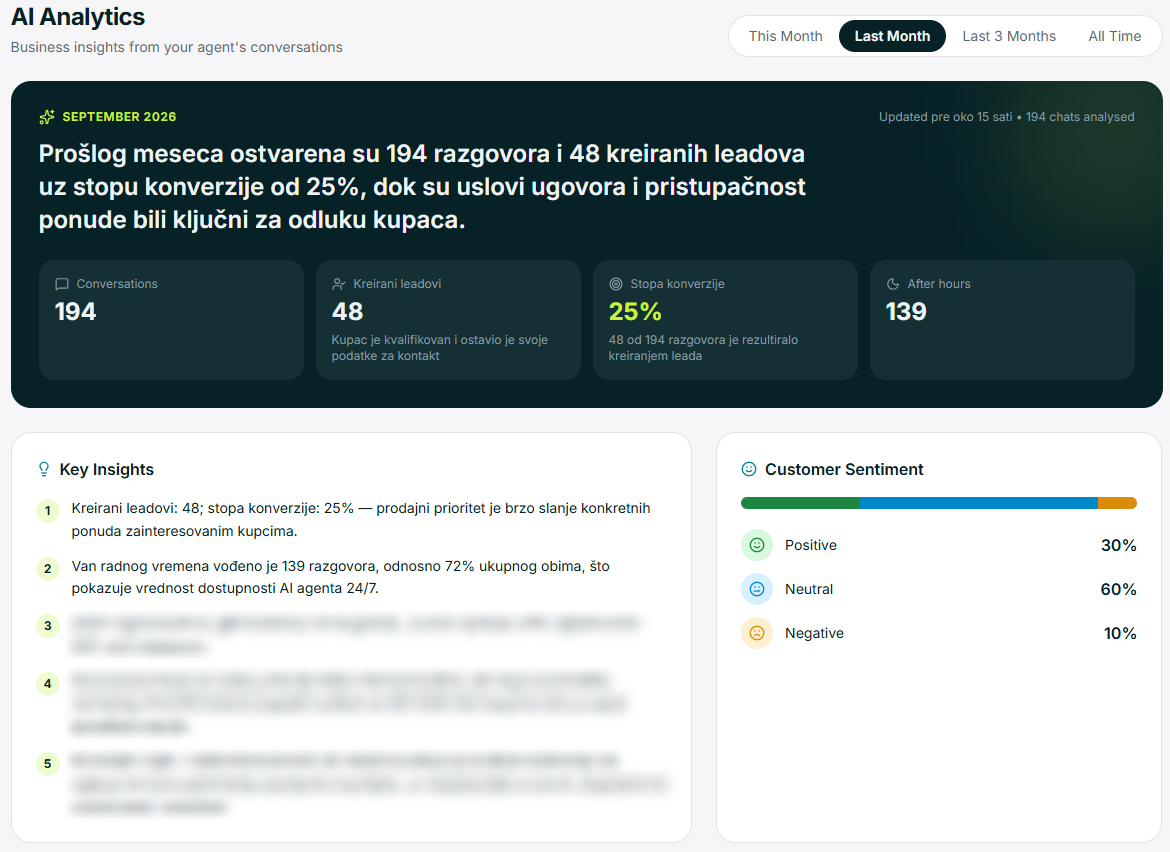
After that comes a regular rhythm. The monthly report shows how many conversations and leads there were, what the conversion rate was, how many conversations come in outside working hours, what customers ask about and which objections keep coming up. When the offer changes, the agent's knowledge changes too.
We do most of the work, but five things can only come from your company:
How long does it take to build an AI agent?
A few weeks. The timeline depends on the scope of the knowledge, the number of integrations and channels, and how quickly the company provides data and access.
How much does an AI agent cost?
The price consists of a one-time implementation and a monthly fee. It depends on the number of agents and channels, the integrations and the volume of conversations, so it is calculated after a look at the sales process.
Can the agent work without integrations?
Yes. The first version can start on knowledge from the website and documents, and connections to the CRM, calendar and other systems are added later.
Can an AI agent make up an answer?
That risk exists with every language model. We reduce it with the behavior map, the knowledge base, clear boundaries, testing before launch and reading real conversations after it. When the answer is not in the sources, the agent says so and passes the question to the team.
Does an AI agent replace a salesperson?
No. The agent takes over the first response, qualification and follow-up, while the salesperson keeps trust, judgment, negotiation and closing the deal.
Whether an agent is well built comes down to one ratio: created leads divided by the number of conversations. The average for our sales agents is around 30%.
Each of these steps affects both the conversion rate and the cost per conversation. That is why the question "how much does an AI agent cost" is incomplete without asking which agent and what return.
The steps are the same in every industry, while the knowledge, qualification and flow of the conversation differ. To see how this looks in practice, take a look at our examples of agents for hotels, car dealerships and e-commerce brands.
With us, the first step is a conversation about your sales process, not about technology. Schedule a demo and we will go through these steps using your sales as the example.


