
Other Blogs


All Blogs

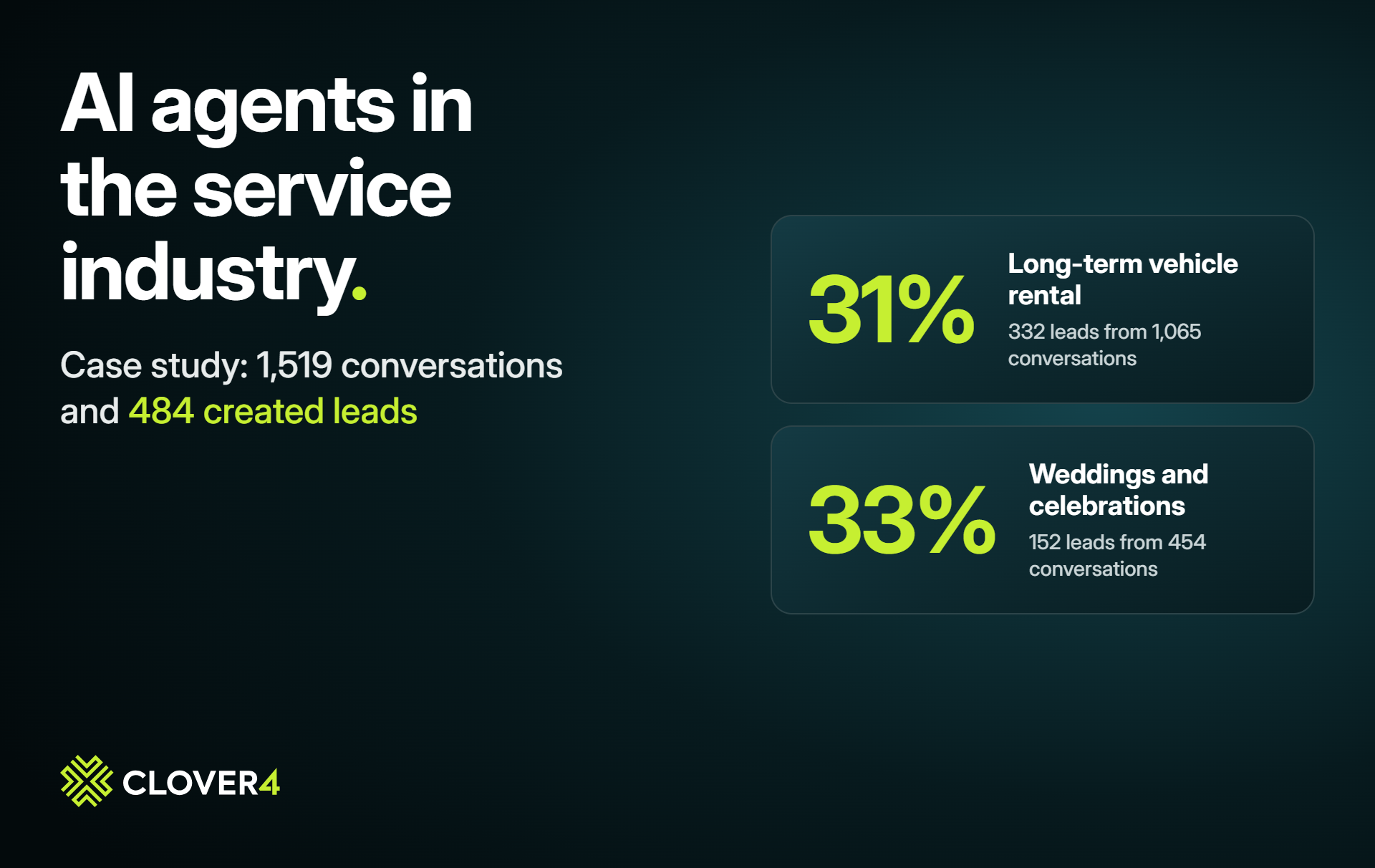

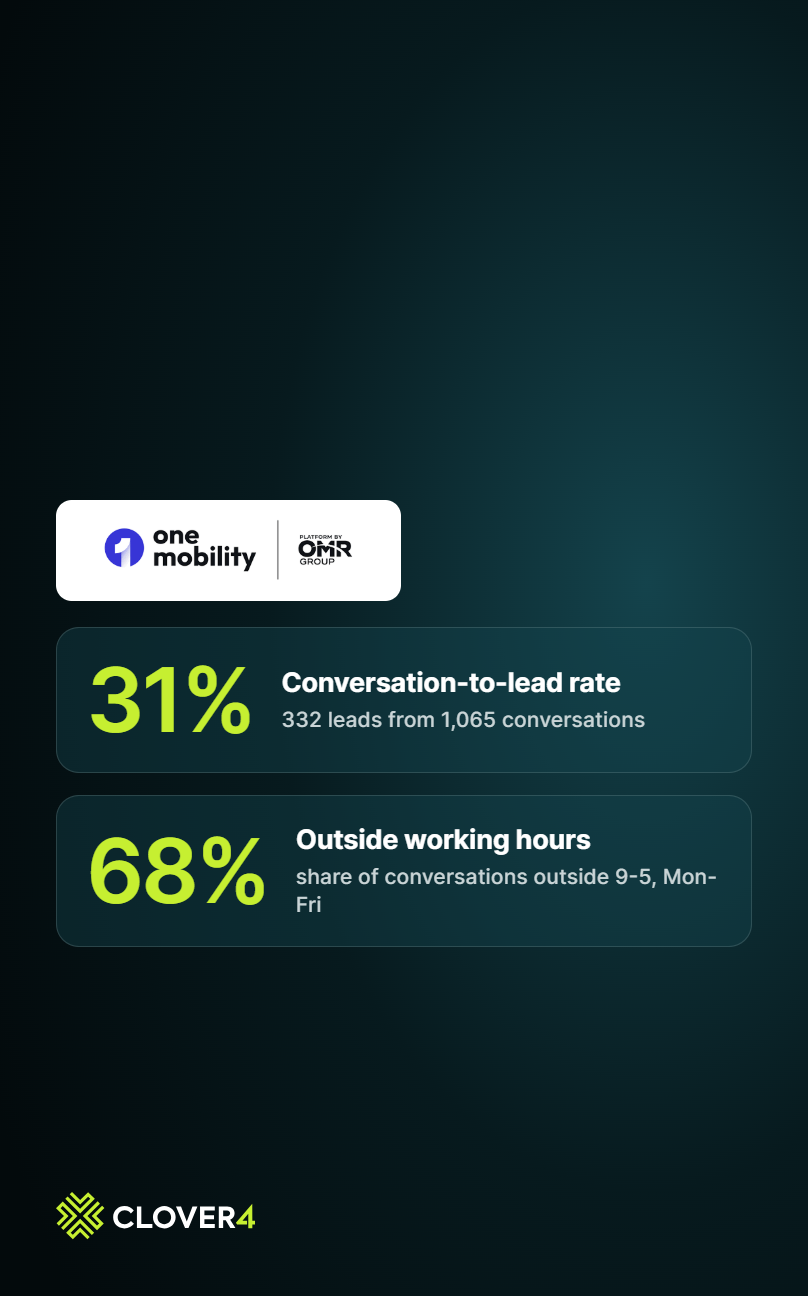
In two service businesses, long-term vehicle rental and wedding and celebration planning, Clover4 sales AI agents handled a combined 1,519 conversations over six months and created 484 leads. The conversation-to-lead conversion rate was 31% in the first case and 33% in the second, and more than 60% of conversations took place outside working hours.
The data comes from the Clover4 client portal as of October 2026 and was presented at the 3rd Sales Congress Serbia in Belgrade on 12 October 2026. Client names are not disclosed.
A service is rarely bought within the conversation itself. Before deciding, the buyer checks terms that depend on their situation, and the deal closes with a salesperson. In long-term rental these are the monthly cost, contract length and approval terms. In celebration planning they are the date, number of guests and budget.
Inquiries arrive throughout the day, while the sales team works set hours. Some come from buyers who are not ready yet or do not meet the conditions. In this kind of sale, an AI agent can take over the first response and qualification, then hand the salesperson a buyer who is ready to talk.
In both cases the agent works as a setter: it brings the salesperson a qualified buyer. Negotiation and closing stay with the salesperson. How this kind of agent is built is described in How to build an AI sales agent.
This rate differs from website conversion, which is calculated across all visitors. The measurement period is six months, up to October 2026.
The average across all Clover4 sales agents is about 30%. The rate changes from month to month: in vehicle rental, September 2026 brought 194 conversations and 48 leads, or 25%. That is why results are assessed over a longer period.
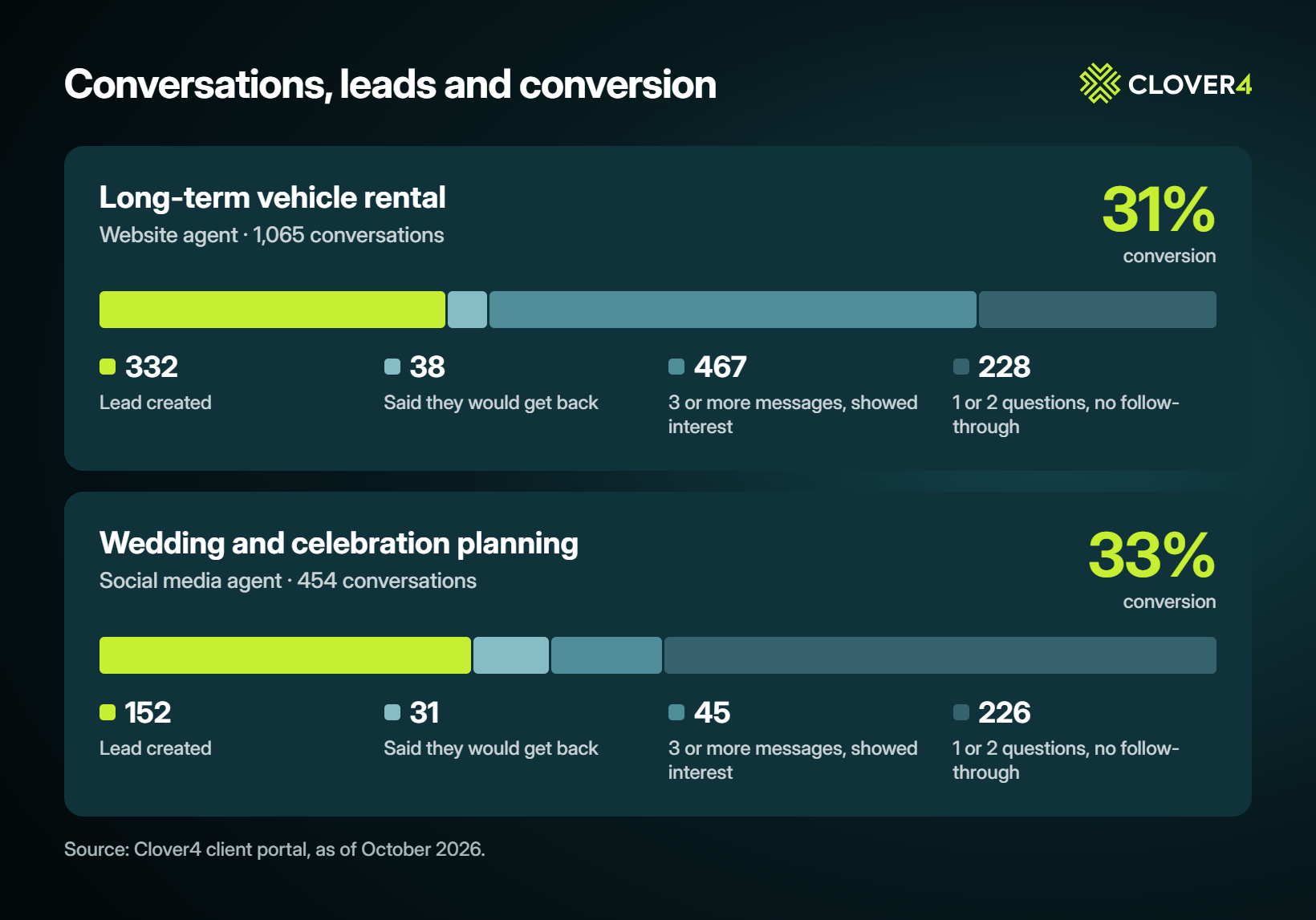
The portal also classifies conversations without a lead. There are 733 in vehicle rental and 302 in celebration planning:
With the website agent, about 21% of all conversations stopped after one or two questions, compared with about 50% for the social media agent. Two examples are not enough to tell whether the channel or the business explains this, and the conversion rate is similar in both cases.
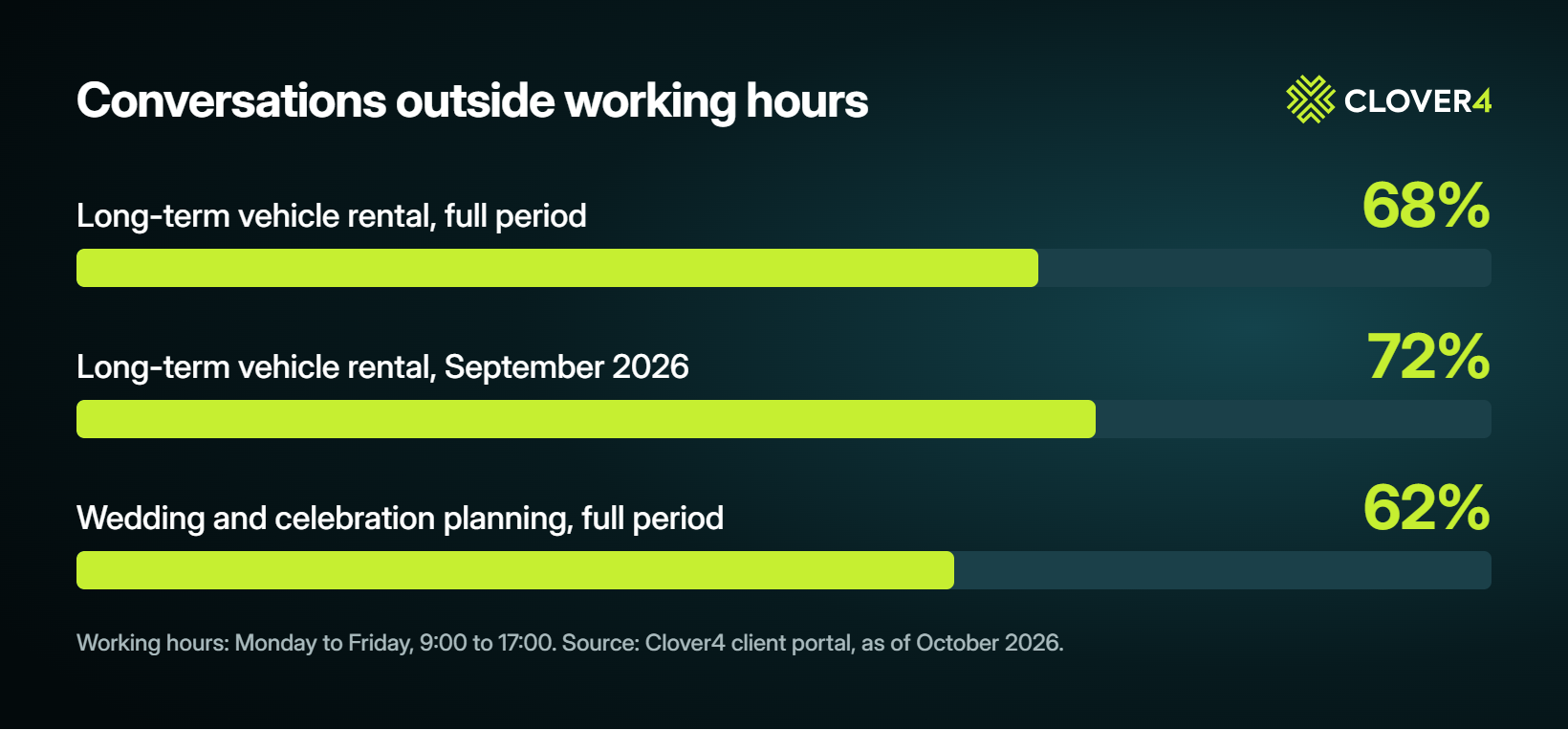
Working hours are counted as Monday to Friday, 9:00 to 17:00. Outside those hours came 68% of conversations in vehicle rental and 62% in celebration planning. In September, the vehicle rental share reached 72%, or 139 of 194 conversations.
In one sample of the vehicle rental lead list, four of six leads were created after 17:00: at 19:19, 19:32, 22:39 and 23:19. Sales picked them up the next morning.
This matters because of response speed. According to research published in Harvard Business Review in 2011, companies that responded within an hour were nearly seven times as likely to qualify a lead as those that responded even an hour later. The same authors audited 2,241 US companies: the average response took 42 hours among companies that replied within 30 days, and 23% never replied.
With each lead, the salesperson receives the buyer's contact details and a conversation summary: the budget, the chosen option, what the agent has already explained and what remains open. In vehicle rental, one buyer asked for a vehicle under 209 euros a month and the agent presented the available options. Another asked about buying with no down payment, and the agent explained that financial leasing requires a 20% down payment and offered long-term rental, which needs no down payment, before the conversation ever reached sales.
Management also receives a monthly analysis of conversations: key insights, the topics buyers raise, objections and sentiment. In vehicle rental, September's main topics were rental and financing terms and price and package choice, with monthly budget and upfront cost among the objections. Sentiment was 30% positive, 60% neutral and 10% negative. This data feeds into refining the offer, marketing and sales training.
Time savings can only be estimated. In vehicle rental, 733 conversations did not become leads, yet all of those buyers got an immediate answer without involving the sales team. The estimate rests on two assumptions: that without an agent half of these buyers would have called or filled in a form, and that handling one such inquiry takes 20 minutes. On those assumptions, the saving is about 122 hours, or 15 working days of one salesperson over six months. For September alone, that is 73 inquiries and about 24 hours, or three working days.
The effect on overall website conversion was not measured for these clients. What follows is an arithmetic model, not a project result. It assumes 20,000 visits over 30 days, with a randomly selected half of visitors seeing the agent.
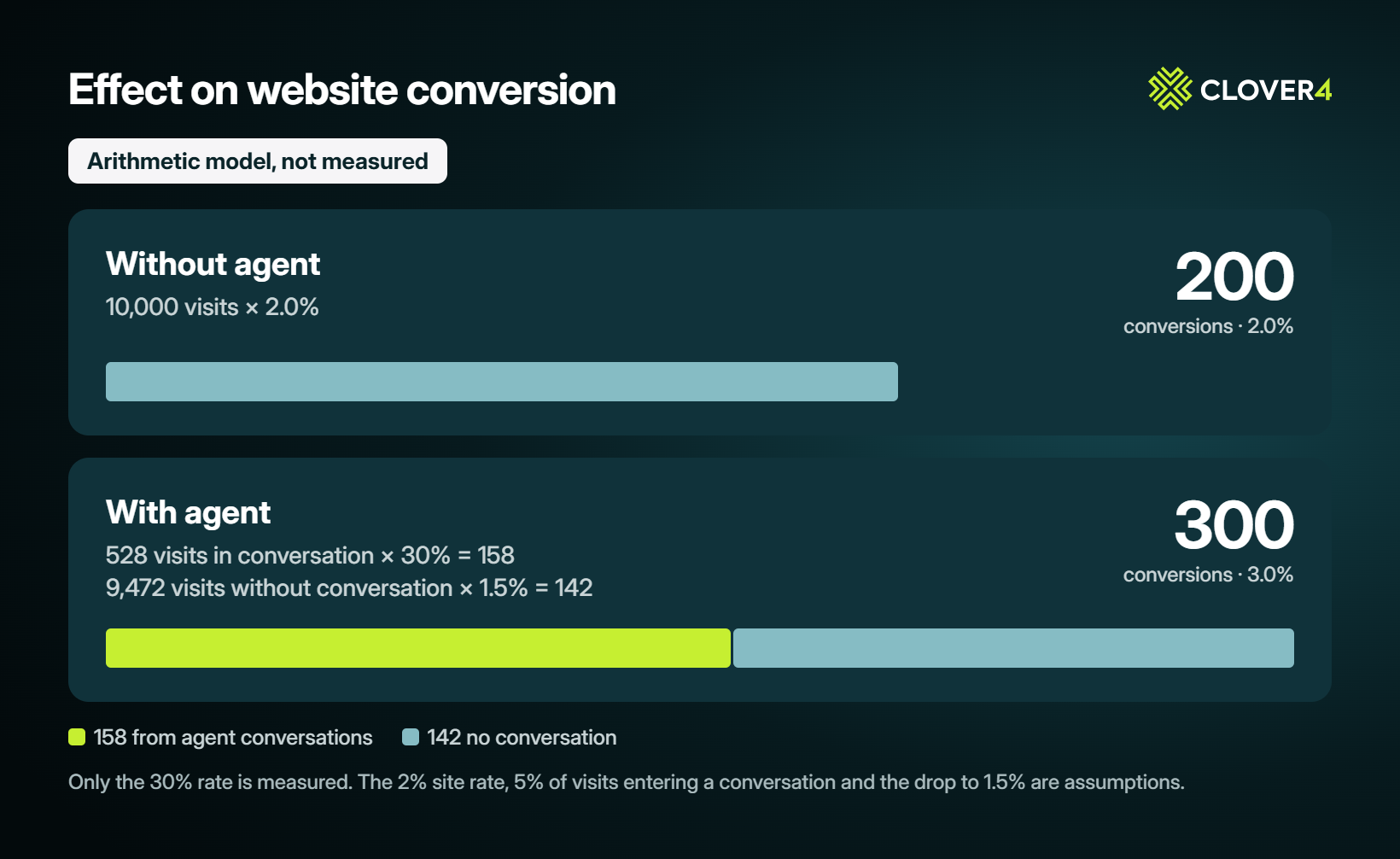
Of the inputs, only the 30% rate is measured. The assumptions are that the site converts at 2% without an agent, that about 5% of visits enter a conversation, and that conversion among visits without a conversation falls to 1.5%, because some buyers who would have reached out anyway now do so through the agent. On that basis, about 58 of the 158 leads would have come without the agent.
The model gives a 50% increase with the same number of visits and the same marketing budget. If half of the 158 buyers would have reached out without the agent, the increase would be about 40%.
The increase depends on two values: the share of visits that enter a conversation and the site's conversion rate without an agent. The more visits talk to the agent, the larger the increase. The lower the starting conversion rate, the larger the percentage increase from the same number of conversation leads. On 10,000 visits, with a 30% rate in conversation, the arithmetic looks like this:
All scenarios assume that about 37% of conversation leads would have come without the agent, as in the base model, but never more than the number of conversions the site has without an agent.
These are arithmetic scenarios, not measured results. The 30% rate may not hold when a larger share of visits enters a conversation, because more of those buyers may be at the start of their decision. A higher percentage increase does not mean more leads: a site at 2% with 390 conversions stays ahead of a site at 1% with 300. The result on a given website is reliably established with an A/B test.
The data covers the period up to the created lead. This study does not include the share of leads that became contracts, because that figure is kept by the clients' sales teams. There was no control group, so it is not possible to determine how many leads would have been created without the agent.
Both examples come from businesses where a salesperson takes over the buyer. In a webshop the goal is a purchase and the conversion rate within conversations is lower, so the 30% result does not transfer to eCommerce.
The same approach applies wherever the volume of visits and messages is high and a conversation can end in a qualified lead: real estate, banking, insurance, private healthcare, telecoms, hospitality and tourism. The result depends on how the agent is prepared: what role it has, what it knows about the offer, what actions it can take and how it leads the conversation. Costs and choosing a solution are covered in AI agent for your website.
To estimate the potential in your company, four figures are needed: the current conversion rate, the share of inquiries outside working hours, the time to first response, and the time salespeople spend on buyers who are not ready. If you would like to see how this could work for you, book a free demo.


